
ByJohn A
Home-Heat Options When a Full Traditional Sauna Will Not Fit
When a full-size traditional sauna does not fit the available space, the realistic options are a compact corner cabin sized for one or two people, a small indoor closet conversion, a barrel-style unit that needs less footprint than a square cabin, or an infrared cabin that runs cooler and skips the stone-and-steam setup entirely. Each trades off differently on footprint, wiring needs, and how close the experience gets to a traditional session, so the right pick depends on which compromise matters least to the household.
1. A compact two-person corner cabin
A corner-configured traditional cabin, built to tuck into an L-shaped footprint against two walls, can fit in as little as 4 by 5 feet, which is small enough for a garage corner, a basement nook, or a tight spot on a deck. It keeps the full traditional experience, stones, steam, and a real heater, just scaled down, and typically pairs with a smaller heater in the 4.5 to 6 kW range that draws less current than a full four-to-six person unit. The tradeoff is capacity: it comfortably fits one person and can feel snug for two.
2. An indoor closet or utility room conversion
Converting an existing closet, mudroom corner, or unused utility space into a small traditional sauna is often the cheapest path to real heat therapy at home, since the framing and exterior walls already exist. This route needs careful attention to vapor barrier and moisture-resistant materials behind the interior wood, since an indoor conversion sits inside conditioned space where a leak or trapped humidity can affect surrounding rooms in a way an outdoor cabin never has to worry about. A licensed electrician still needs to run the appropriate circuit, and ceiling height matters more here than in a standalone cabin, since most conversions max out around 7 feet.
3. A barrel-style sauna
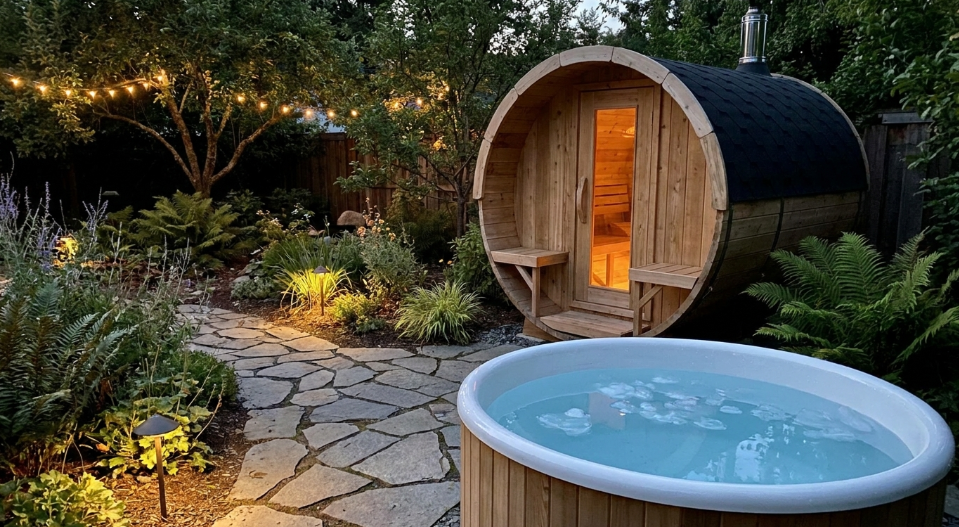
A barrel sauna’s curved shape sits on a cradle rather than a flat foundation, and the design sheds rain and snow off the roofline naturally, which makes it a reasonable pick for a narrow side-yard strip where a square cabin’s roof would need more careful drainage planning. Barrel units typically run 6 to 8 feet in diameter and need less total footprint than an equivalent-capacity square cabin, though the curved walls do eat into usable bench depth compared to a rectangular room. Dealers that list barrel dimensions alongside square cabin options side by side, Sweat Decks among them, make the footprint tradeoff easier to see before committing to a shape.
4. A shared multi-use outbuilding retrofit
Some households retrofit part of an existing shed, pool house, or detached garage bay into a sauna rather than building a dedicated structure. This works well when the space already has some electrical service nearby, cutting the wiring cost, but it requires real attention to insulation and interior finish since most outbuildings are not built to hold the humidity and heat a sauna session generates. Ventilation is the detail most often underplanned in this option, since a converted space needs the same intake-and-exhaust vent setup as a purpose-built cabin, not just an open window.
5. An infrared cabin as a lower-footprint, lower-heat alternative
An infrared cabin swaps the stone-and-steam heater for carbon or ceramic panels that heat the body more directly at a lower air temperature, typically 120 to 150 degrees compared to 170 to 190 for a traditional unit. Many infrared cabins plug into a standard 120V outlet, which sidesteps the 240V circuit a traditional heater usually needs, and the units themselves often have a smaller footprint since there’s no stone bed or heater guard clearance to plan around. The session experience is genuinely different though, more like a gentle full-body warmth than the intense steam of water hitting hot stones, and that difference matters to people who specifically want the traditional löyly experience.
6. A portable or tent-style sauna for renters
For renters or anyone who can’t install a permanent structure, portable tent saunas with a small electric heater are the last resort worth mentioning. They set up and pack down in minutes, need only a standard outlet, and cost a fraction of any permanent option, but the experience is noticeably different, thinner materials, less consistent heat, and no real bench to speak of. This category makes sense as a way to try sauna use regularly before committing to a permanent installation, not as a long-term substitute for one.
What does the evidence say about smaller or less intense sessions?
Most of the strongest cohort evidence on sauna bathing comes from traditional Finnish-style sessions at higher temperatures, and a Mayo Clinic Proceedings review of that literature found regular bathing associated with lower cardiovascular and all-cause mortality risk. A separate review focused specifically on physiological effects of heat exposure notes that the underlying cardiovascular response scales with heat and duration, which suggests a compact traditional cabin used consistently is likely to track the cohort evidence more closely than an occasional infrared session at a lower temperature, though nothing in the literature directly compares session formats. These remain association findings from observational research rather than a controlled comparison of formats.
Frequently Asked Questions
Is a smaller sauna less effective than a full-size one?
Not necessarily, since the heat and humidity a bather experiences depends more on the heater and session length than on the room’s total size. A well-built compact cabin delivers a comparable session to a larger one, just with less room for multiple people.
Can an indoor sauna conversion cause moisture damage?
It can if the vapor barrier and ventilation aren’t handled correctly, since indoor conversions sit inside conditioned living space. Proper materials and a real intake-and-exhaust vent setup are what prevent that.
Does a barrel sauna need a different foundation than a square cabin?
Barrel units sit on a cradle rather than a flat foundation, which changes the setup but doesn’t eliminate the need for a level, well-drained base underneath.
Is an infrared cabin a good substitute for a traditional sauna?
It depends on what someone wants. Infrared runs cooler and skips the steam entirely, which some people prefer, but it isn’t the same session as steam hitting hot stones for anyone specifically after that experience.
How small can a real traditional sauna actually be?
A corner-configured cabin can fit into roughly a 4-by-5-foot footprint while still using a genuine stone-filled heater, which is the smallest size most manufacturers consider a full traditional experience rather than a novelty unit.
References
- Cardiovascular and Other Health Benefits of Sauna Bathing: A Review of the Evidence, Mayo Clinic Proceedings, 2018
- Effects of heat and cold on health, with special reference to Finnish sauna bathing, American Journal of Physiology, 2018
- Clinical Effects of Regular Dry Sauna Bathing: A Systematic Review, Evidence-Based Complementary and Alternative Medicine, 2018
- Electrical and fire safety standards, National Fire Protection Association
